Chairs are great, they make it comfortable to sit in the same or similar position for hours on end. But like most technology, it has its own cons. Sitting in chairs for hours is an unnatural position for our bodies, and often causes decreased mobility and stiffness. The second way that can help revert the cons of sitting in chairs for hours is practicing the deep squat.
How do you do the deep squat?
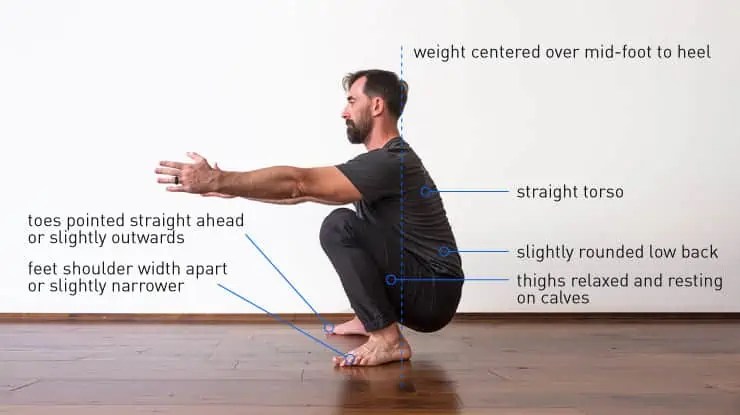
- Stand with your feet slightly wider than shoulder-width apart, toes pointing slightly outward.
- Descend into a deep squat: Lower your body by bending your knees and pushing your hips back, as if you’re sitting into a chair. Keep your heels planted on the floor and maintain a straight back throughout the movement.
- Find your comfortable depth: Descend until your hips are lower than your knees, and adjust your foot positioning or stance width if necessary to find a comfortable position. Aim for a rock-bottom position where your buttocks are close to the ground.
- Maintain the position: Once you’re in the deep squat, focus on maintaining the position. You can use your elbows to gently push your knees outward, which can help improve your hip mobility and stability. Keep your chest up, back straight, and your weight balanced evenly between your feet.
- Gradually increase duration: Start by holding the deep squat for a short duration, such as 10 to 15 seconds. As you become more comfortable, gradually increase the time you spend in the position. Aim to work up to 1-2 minutes or longer, depending on your capabilities.
- Breathe and relax: Take deep breaths and consciously relax your muscles while in the deep squat position. Relaxing into the position can help improve your flexibility and allow you to rest comfortably.
- Regular practice: Consistency is key to improving your ability to rest in the down position. Include regular squat holds in your training routine, aiming for multiple sets throughout the week.
- Supportive exercises: Strengthening exercises like goblet squats, lunges, and hip mobility drills can complement your deep squat practice and help build the necessary strength and mobility for a comfortable deep squat position.
Here are the benefits I have noticed from practicing the deep squat in my training, aligned with findings from research on the topic:
- Increased Hip Range of Motion and Decreased Muscle Stiffness: A study published in the Journal of Strength and Conditioning Research revealed that deep squatting exercises can significantly increase hip range of motion and reduce muscle stiffness in the lower body. The deep squat position involves flexion at the hips, knees, and ankles, which stretches and mobilizes the muscles and joints involved. By regularly practicing deep squats, I was able to regain lost mobility and alleviate the stiffness caused by prolonged sitting.
- Improved Balance and Dynamic Stability: The Journal of Sports Science and Medicine published a study indicating that deep squatting can enhance balance and dynamic stability in healthy adults. Deep squat exercises engage the muscles responsible for stability, including the core, glutes, and quadriceps. By strengthening these muscles and improving their coordination, I saw an increase in my overall balance and stability, and find it easier to not fall or slip when losing footing.
- Reduced Risk of Knee Injuries: Athletes, in particular, can benefit from incorporating deep squatting into their training routine. The Journal of Sports Rehabilitation featured a study highlighting the ability of deep squat exercises to reduce the risk of knee injuries. Deep squats help strengthen the muscles surrounding the knee joint, including the quadriceps, hamstrings, and glutes, providing greater stability and support. This added strength can help athletes mitigate the stress placed on the knee during activities like jumping, pivoting, or sudden directional changes, ultimately reducing the likelihood of knee-related injuries. When bouldering, indoors especially, it’s common to fall from 10-15 ft onto pads both voluntarily and involuntarily. I’ve definitely noticed a decrease in pain or stiffness from this.
- Enhancing Indoor Rock Climbing Performance: Deep squatting exercises can offer several advantages for indoor rock climbers. The increased hip mobility gained through deep squatting can aid climbers in achieving more effective and efficient movements. It allows for better foot placement, hip rotation, and weight distribution, enabling climbers to tackle challenging routes with greater ease and fluidity. Additionally, the enhanced stability and balance derived from deep squatting can significantly improve climbers’ ability to maintain body control on the wall, particularly during dynamic movements or when transitioning between holds.
These are just a few of the benefits I’ve noticed in my own life by regularly practicing the deep squat. It clearly offers a valuable solution to combat the negative effects of prolonged sitting, restoring mobility, and reducing stiffness. Even better, it allows me as an athlete to benefit from increased mobility and reduce risk of injury.
Just a few minutes a day of this exercise can make a difference, and I hope others can benefit from it too.
 Life's not about quick fixes
Leave a comment